B2B transport, short for business to business, is freight that moves directly from one business to another. You load your goods at your premises, the carrier takes them, and your customer unloads at theirs. The freight stays on the one truck the whole way, without being sorted through a depot in the middle.
It sounds simple, and it is. But that simplicity is exactly why B2B is often the best way to move business freight, especially when the goods are fragile, valuable or neatly stacked.
How B2B transport works
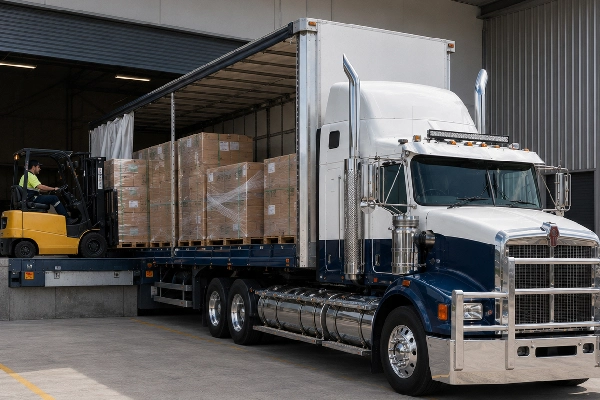
The flow is straightforward. You load your freight at your dock, stacked and secured the way you want it. The carrier restrains it and drives it directly to your customer. Your customer unloads at their end with their own forklift or dock. The carrier confirms delivery and, if needed, provides a signed proof of delivery.
The defining feature is that both ends stay in control of their own goods, and the freight spends the entire trip on a single vehicle. You load, your customer unloads, and nothing happens to the freight in between except the drive.
Why B2B protects your freight
To see the benefit, it helps to understand the alternative. A lot of freight passes through a depot, where it's unloaded, sorted, stored and reloaded onto another truck. Every one of those steps is a chance for a pallet to be knocked, a carton to be crushed, or an item to go missing.
B2B cuts all of that out. Your freight is handled once at your end and once at your customer's, and not at all in between. For fragile stock, high-value goods or freight that has to arrive looking presentable, that single-handling trip is the difference between a clean delivery and a damage claim.
The business benefits beyond damage
Less damage is the headline, but B2B brings other advantages too.
Faster delivery
Freight that goes direct doesn't wait at a depot for consolidation or sorting. It leaves your dock and arrives at your customer's, so transit time is basically the drive itself.
A better impression
When your delivery arrives on time and in good order, it reflects on your business. Your customer judges you partly on how your freight turns up, and clean, direct delivery makes you look reliable.
Simpler and more predictable
With no depot in the loop, there are fewer moving parts and fewer things to go wrong. That makes timing more predictable, which matters when your customer is planning around the delivery.
Who B2B transport suits
B2B is a natural fit for a lot of businesses:
- Wholesalers supplying retailers and trade customers
- Manufacturers sending finished goods to distributors
- Suppliers delivering full or part pallets to business customers
- Importers moving cleared stock from the Port to a customer's warehouse
- If your customers are other businesses with docks or forklifts, B2B is almost always the cleaner, faster way to supply them.
Is B2B right for you?
B2B works best when both ends can load and unload their own freight, which most businesses with a dock or forklift can. If your customer can't unload, a tail-lift truck can bridge the gap, bringing the freight to ground level without a forklift. So even deliveries to smaller business customers can often still run as a direct B2B job.
B2B transport with Road Linx
At Road Linx we run B2B freight across Brisbane, South East Queensland and into Northern NSW, keeping your goods on one truck from your dock to your customer's. We can set it up as an account with standing runs to your regular customers, capturing how each one likes to receive freight, so your deliveries become something you don't have to think about. If your business supplies other businesses, B2B is worth a conversation.
Setting up a B2B run that looks after itself
The real value of B2B shows once it's set up as an ongoing arrangement. Instead of booking each delivery, you agree the regular runs once, and the carrier captures how each of your customers likes to receive freight: their delivery windows, their site access, their receiving contacts and any quirks.
From there the deliveries just happen. Your driver turns up at the distribution centre knowing it only receives before 11am, or brings goods to the rear of a particular store without being told. Those small details are what turn your deliveries from a source of complaints into a quiet reason customers keep buying from you.
For a supplier, that reliability is worth a lot. Your freight becomes something you don't have to think about, and your customers come to rely on deliveries that simply arrive right.
The bottom line
B2B transport keeps your freight on one truck from your dock to your customer's, cutting out the depot handling that causes most damage and delay. For any business supplying other businesses, it's usually the cleaner, faster and more professional way to deliver.