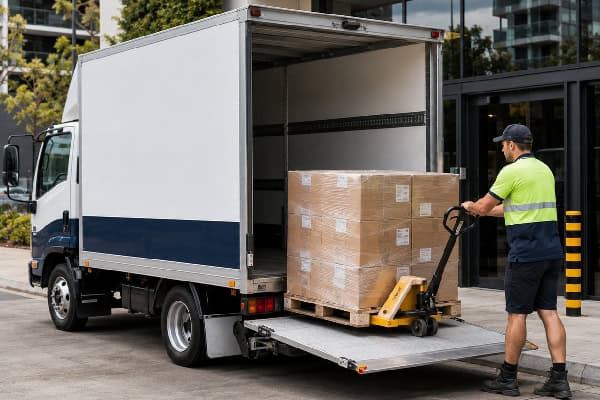
A taxi truck is a truck you book for a single job, the same way you'd hail a taxi. It turns up, moves your load from one place to another, and you pay for that trip rather than a day rate or an ongoing contract. Sizes usually run from small one-tonne utes up to trucks around 12 tonnes, so a taxi truck can shift anything from a couple of cartons to several pallets.
If you've ever had a load that was too big for a courier but nowhere near enough to justify booking a full truck for the day, a taxi truck is the answer to that exact problem.
Taxi truck vs courier: what's the difference?
People often use the words loosely, but they're different services. A courier moves parcels and small items, usually in a car, a bike or a small ute. Think documents, satchels and boxes you could lift yourself.
A taxi truck handles the bigger stuff. Pallets, furniture, equipment, building materials, anything that needs a truck and often a trolley or a tail lift to handle. The rule of thumb: if it fits in a car, it's a courier job, and if it needs a truck, it's a taxi truck job.
How much does a taxi truck cost?
Because you're paying for the trip rather than hiring the truck for a day, the cost comes down to three things: the size of truck the load needs, the distance travelled, and how urgent it is. A small ute across a few suburbs is cheap. A larger truck across a longer distance costs more, and an urgent same-day dash costs more again.
The point is that you only pay for the job in front of you. That's what makes a taxi truck cost-effective for one-off and ad-hoc loads, where hiring a truck by the day would mean paying for hours you don't use.
When to use a taxi truck
Taxi trucks earn their place in a handful of common situations:
- A pallet or two has to get across town today and can't wait for a scheduled run
- A courier ute is too small but a semi-trailer would be overkill
- You've got a genuine one-off and don't want to set up an account or a schedule
- Something was left off a load and needs to catch up before a job starts
- A customer needs stock now and your own vehicles are all out
- In each case, the taxi truck fills a gap that neither a courier nor a full freight booking handles well.
Choosing the right size
Sending a truck that's too big wastes money, and one that's too small means a second trip. A rough guide helps.
Small utes and utes
For a single pallet, a few cartons or small items, a one-tonne ute or flat-top ute is quick and cheap. This is the go-to for light, urgent metro runs.
Mid-size to larger trucks
Once you're up to several pallets or heavier gear, a three to 12-tonne truck is the right call. Many carry a tail lift, so they can still deliver to a site with no forklift, which matters more often than people expect.
Common mistakes to avoid
Two mistakes come up again and again. The first is under-describing the load, which leads to the wrong truck turning up and a wasted trip. Give the operator a realistic idea of size, weight and pallet count so they send the right vehicle the first time.
The second is forgetting to mention access. If there's no forklift at the delivery point, or the street is tight, say so up front. A tail-lift truck or a smaller vehicle solves it, but only if the operator knows before they dispatch.
Taxi trucks in Brisbane
In a spread-out city like Brisbane, taxi trucks are a practical way to move freight quickly between the industrial estates, the Port and the suburbs without committing to a full-day hire. At Road Linx we run taxi trucks across the metro and beyond, sized from utes to 12-tonne trucks, and for genuinely urgent loads our hot shot service runs a dedicated dash straight there.
If you're weighing up whether a taxi truck suits your job, the quickest way to find out is to describe the load and let us match the right truck to it.
A few real-world taxi truck jobs
It helps to picture the kind of work taxi trucks actually do. A cabinet maker needs three finished units delivered across town before a site install that afternoon. A wholesaler has a pallet a courier won't take and a customer who needs it today. An office is relocating a room of furniture and a car won't cut it.
None of these are courier jobs, and none justify hiring a truck for the whole day. They're classic taxi truck work: one trip, the right sized truck, priced for the job. That flexibility is why businesses that mostly run their own vehicles still keep a taxi truck operator's number handy for the busy days and the one-offs.
The takeaway is that a taxi truck fills the awkward middle of the freight world, and once you've used one for the right job, you tend to reach for it again.
The bottom line
A taxi truck is the right tool when a load is too big for a courier and too small for a full truck, and you'd rather pay for the trip than the day. Get the size right, mention any access issues, and it's one of the simplest, most flexible ways to move freight around a city.