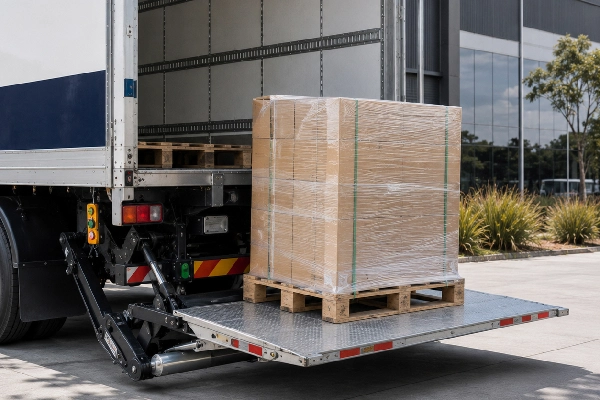
A tail-lift truck has a powered platform on the back that raises and lowers freight between the truck deck and the ground. That platform, the tail lift, is what lets a truck deliver heavy or palletised goods to places that have no forklift and no loading dock. A delivery made this way is called a tailgate delivery.
It sounds like a small feature, but it quietly solves one of the most common problems in freight: what happens when the delivery point can't get the goods off the truck.
How a tail lift works
The tail lift is a hydraulic platform that folds up against the back of the truck when travelling. At the delivery point, the driver folds it out, the freight is moved onto it at deck height, and the platform lowers under power to the ground. A pallet weighing several hundred kilos comes down smoothly and under control, no forklift required.
The same works in reverse for pickups, lifting freight from the ground up to the deck. The driver operates it, and on a well-run job the freight is restrained on the platform so nothing shifts while it moves.
Why tailgate delivery matters
Most freight quietly assumes there's a forklift waiting at the other end. A huge amount of the time, there isn't. Shopfronts, cafes, gyms, homes, small units and building sites often have no lifting equipment at all.
Without a tail lift, the options at those places are bad. Either the freight is manhandled off the truck, which risks injuries and damage, or the delivery fails and goes back on the truck. A tail lift removes that problem entirely.
When you need a tail-lift truck
Reach for a tail-lift truck whenever the delivery or pickup point can't lift the freight itself. Common cases include:
- Retail shopfronts and strip shops with no rear dock
- Cafes, gyms and fit-outs receiving heavy equipment
- Residential and home-business deliveries
- New or interim premises before a forklift and dock are installed
- Construction sites where the forklift is tied up or not there yet
If the freight is heavier than a couple of people should safely lift, and the site can't lift it for you, a tailgate delivery is the safe answer.
What to tell your carrier
A tailgate delivery goes smoothly when the carrier knows what the truck is arriving to. The tail lift needs firm, level ground to work on, so a few details up front prevent a failed drop. Mention the ground surface, whether it's sealed, gravel or grass, any slope near where the truck will park, the truck access and any low clearances, and how far the freight has to travel from the truck to its final spot.
Soft or steeply sloped ground can limit how a tail lift operates, so it's always worth flagging rather than leaving the driver to discover it on arrival.
A common misconception
People sometimes assume a tail lift is only for small deliveries. In fact, tail-lift trucks range from around three tonnes up to 12 tonnes, so they handle everything from a single appliance to multiple heavy pallets, all to a ground-level site. The limit is the platform's rating and the truck's capacity, not some small ceiling.
Tail-lift delivery with Road Linx
We run tail-lift trucks from three to 12 tonnes across Brisbane and the wider region, which means we can deliver almost anywhere, not just to sites set up for trucks. Tail-lift capability also folds into our other work, so a distribution run, a taxi truck job or a warehouse move can all use a tail-lift vehicle for the drops without a forklift. Just tell us a delivery has no lifting gear and we'll send the right truck.
Using the tail lift safely
A tail lift is only as good as the way it's operated, and that's mostly about the ground and the load. The platform needs firm, level footing, because a soft or sloped surface can make it unstable. The freight needs to be positioned and, where needed, restrained on the platform so it can't roll or tip as it moves.
This is why the driver runs the tail lift rather than leaving it to whoever's on site. A trained operator knows the platform's rating, positions the load correctly and lowers it under control. It's also why flagging the delivery conditions ahead of time matters, since it lets the driver arrive prepared for the ground they're working on.
Done properly, a tailgate delivery is smooth and safe, and it turns a site that couldn't otherwise take heavy freight into one that can.
The bottom line
A tail-lift truck turns almost any address into a place you can deliver heavy freight, no forklift or dock required. Whenever the delivery point can't lift the goods itself, a tailgate delivery is the safe, simple answer, and it folds neatly into taxi truck, distribution and relocation work too.