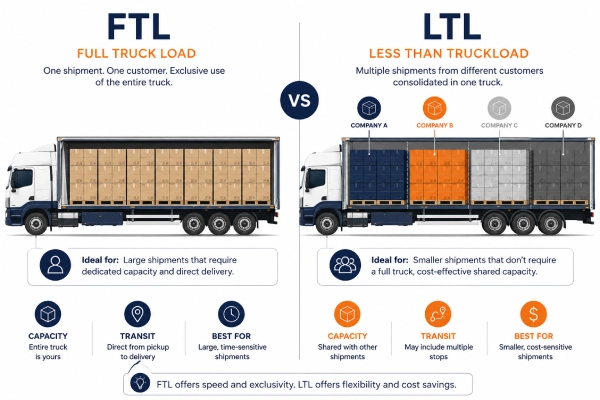
FTL means full truck load, where one truck carries only your freight direct from pickup to delivery. LTL means less than truck load, sometimes called part load, where your freight shares a truck with other customers' goods and often passes through a depot to be sorted along the way.
Choosing between them is one of the most common freight decisions a business makes, and getting it right can save you both money and headaches. Here's how to think about it.
What is full truck load (FTL)?
With FTL, the truck is dedicated to you. It loads your consignment, drives straight to the destination, and unloads. Nothing else goes on board and there are no depot stops in the middle. That makes FTL fast, and it means your freight is handled once at each end rather than sorted and reloaded along the way.
What is less than truck load (LTL)?
LTL is shared freight. Your goods travel with other consignments on the same vehicle, which is efficient when you only have a small load. The trade-off is that LTL usually involves consolidation at a depot, waits for a full vehicle, and more handling, so it takes longer and carries a slightly higher damage risk.
The pros and cons side by side
Neither option is better in the abstract. It depends on your freight.
FTL is stronger when
- You have enough freight to fill most of a trailer
- The delivery is time-critical and can't wait for a full vehicle
- The goods are fragile, high-value or shouldn't be handled repeatedly
- You want a single, direct, point-to-point run
LTL is stronger when
- You only have a few pallets or a small consignment
- Timing is flexible and a day or two either way doesn't matter
- Cost matters more than speed for that particular load
- The freight is sturdy and handles depot sorting well
How to work out which is cheaper
The instinct is that sharing a truck must be cheaper, and for small loads it usually is. But there's a tipping point. Once your freight fills the bulk of a trailer, you're effectively paying LTL rates on a near-full load, and at that point FTL is normally cheaper per pallet because you're not subsidising the handling of other people's goods.
A good rule: if your load takes up more than half to two-thirds of a trailer, price it both ways. You'll often find FTL wins on both cost and speed.
Speed and handling matter too
Cost isn't the only factor. If a delivery date can't slip, FTL's direct transit is worth paying for, because LTL freight waits for a full vehicle and adds depot time. And if your freight is delicate or neatly stacked, the single-handling trip of FTL protects it in a way shared, sorted freight can't.
A common mistake
The most frequent error is defaulting to LTL for everything to save money, then paying for it in missed dates and damage. If your load is large, urgent or fragile, don't assume shared freight is the economical choice. Run the numbers, and factor in the cost of a late or damaged delivery, not just the freight rate.
FTL with Road Linx
At Road Linx we run FTL freight on 22 and 24-pallet trailers across South East Queensland and into Northern NSW, matching the trailer to your load. Because the truck is dedicated to you, we can also handle a planned multi-drop to a couple of related sites on the one direct run. If you're not sure whether your freight suits FTL or a part load, tell us the details and we'll advise honestly on which works out better.
A worked example
Say you've got 16 pallets of light packaging to move from Brisbane to the Gold Coast. On LTL, those 16 pallets take up most of a shared trailer anyway, so you'd be paying part-load rates on what's nearly a full load, and waiting for the truck to fill and route via a depot.
Priced as FTL, a dedicated 24-pallet trailer carries all 16 direct, often for less per pallet and certainly faster. The lesson is that once your load creeps past half a trailer, the assumption that shared freight is cheaper stops holding, and it's worth pricing both ways.
The reverse is just as true. Two pallets of hardware with a flexible delivery date almost always belong on LTL, where sharing the truck is exactly the point. Matching the freight to the method is the whole skill.
The bottom line
FTL and LTL aren't rivals, they're tools for different jobs. Small, flexible loads suit shared LTL freight. Large, urgent or fragile loads suit a dedicated FTL run. When your freight sits in the middle, price it both ways and factor in the cost of a late or damaged delivery, not just the rate.