
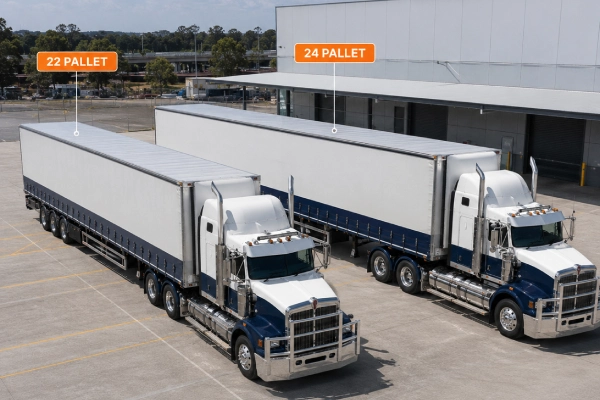
When you're moving a full load on a semi-trailer, one of the first questions is how many pallets it holds. The two configurations you'll hear about most are 22-pallet and 24-pallet trailers. They sound almost the same, but the difference can affect both what fits and what it costs, so it's worth understanding before you book.
Here's a straightforward look at the two, and how to work out which suits your freight.
How pallet capacity works
A standard Australian pallet is 1165mm by 1165mm. The number of pallets a trailer holds depends on its deck length and how the pallets sit on it. A 24-pallet trailer has the deck to take 24 standard pallets in a single layer, while a 22-pallet configuration fits 22.
On paper, 24 sounds strictly better, more pallets for a similar trailer. But floor space is only half the story. The other half is weight.
When floor space is the limit
For light, bulky freight, you'll run out of floor before you run out of legal weight. Think packaging, empty containers, or light finished goods. In that case, more pallet positions is genuinely better, and a 24-pallet trailer lets you move more in a single run. If your freight is light and you're filling the deck, the 24 is usually the way to go.
When weight is the limit
For heavy freight, the opposite is true. Trucks have legal mass limits, and dense pallets can hit that limit well before the deck is full. When weight is the constraint, the number of pallet positions barely matters, because you physically can't load them all without going overweight.
This is where a 22-pallet trailer can actually suit better. The configuration is often set up to carry heavier freight within the axle and mass limits, so for dense loads it can be the more practical choice. Loading a 24-pallet trailer with heavy freight just means leaving positions empty to stay legal.
So which should you choose?
The honest answer is that it depends on your freight, and specifically on whether you hit the weight limit or the floor limit first.
- Light, bulky freight that fills the deck: a 24-pallet trailer moves more per run
- Heavy, dense freight that hits mass limits: pallet count matters less, and a 22 can suit
- A mix: tell your carrier the pallet count and the total weight, and let them advise
The key number to give your carrier isn't just how many pallets you have, it's how much they weigh. With both figures, a good operator can tell you immediately which trailer gets your freight moved most efficiently and legally.
A common mistake
The frequent error is booking purely on pallet count and ignoring weight. A business books a 24-pallet trailer for 24 heavy pallets, then finds only 18 or 20 can go on before the truck is at its legal limit. The result is a wasted run and freight left behind. Give weight and pallet count together and this doesn't happen.
What if one trailer isn't enough?
If your load genuinely needs more than a single trailer, there are higher-capacity options depending on the freight and the route. It's worth a conversation rather than assuming you're stuck with two separate runs. The right combination often depends on where the freight is going and what road access allows.
Getting the right trailer with Road Linx
We run both 22 and 24-pallet trailers, in tautliner, flat-top and drop-deck configurations, so we can match the trailer to your load rather than forcing your freight to fit. Tell us the pallet count, the pallet type and the total weight, and we'll tell you which trailer gets it there in one efficient, legal run. If your freight is heavy, that advice can save you a wasted trip.
Light versus heavy: a quick example
Picture two loads. The first is 24 pallets of empty plastic crates, light and bulky. That load fills the deck long before it troubles the weight limit, so a 24-pallet trailer is perfect and moves the lot in one run.
The second is 24 pallets of tiled flooring, dense and heavy. Load all 24 and you're well over the legal mass limit, so in practice only a portion can travel at once regardless of how many positions the trailer has. Here the pallet count is a red herring, and the real question is how much weight you can legally carry per run.
Same pallet count, completely different trailer decision, decided entirely by weight. It's the clearest illustration of why you should always give your carrier both numbers.
The bottom line
Pallet count tells only half the story. For light, bulky freight a 24-pallet trailer moves more per run, while for heavy freight the weight limit decides things and a 22 can suit better. Give your carrier the pallet count and the total weight, and the right choice becomes obvious.