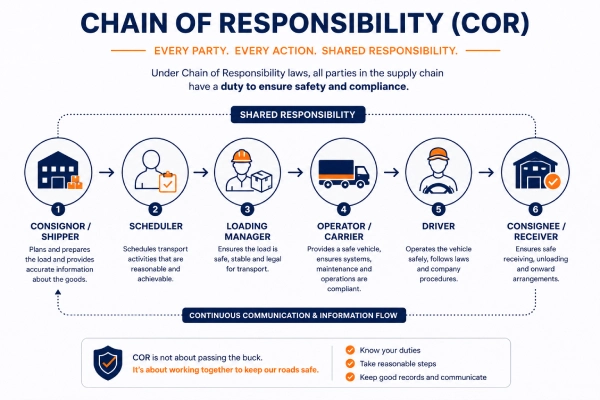
Chain of Responsibility, usually shortened to COR, is the law that spreads legal responsibility for heavy-vehicle safety across everyone involved in a freight task, not just the driver behind the wheel. If your business sends or receives freight, COR almost certainly applies to you, and it's worth understanding why.
This guide explains COR in plain terms: what it is, who it covers, and the practical steps a business can take to stay on the right side of it.
What is Chain of Responsibility?
COR sits within the Heavy Vehicle National Law, administered by the National Heavy Vehicle Regulator, or NHVR. The core idea is simple. For years, if a truck was overloaded or a load wasn't restrained, the driver copped the blame. COR recognises that the driver is often the last link in a chain of decisions made by other people, and it holds those people responsible too.
In other words, if your loading dock sends out an overloaded or badly restrained truck, the responsibility doesn't stop with the driver. It reaches back to your business.
Who is in the chain?
The chain covers any party who has control or influence over a heavy-vehicle transport task. Depending on the job, that can include:
- The operator or transport company running the vehicle
- The consignor, the business sending the freight
- The consignee, the business receiving it
- The loader who physically loads the truck
- The packer, and schedulers who set delivery times
- Managers and directors whose decisions affect safety
You don't have to touch the truck to be in the chain. Setting an unrealistic delivery deadline that pressures a driver to speed or skip a rest break can put you in it just as much as loading the trailer yourself.
What COR asks of you
The central duty under COR is to take all reasonable steps to ensure the safety of your transport activities, so far as is reasonably practicable. That covers a few main risk areas: vehicle mass and loading, load restraint, speed, and driver fatigue.
For a business that sends freight, the practical questions are things like: are we loading trucks within their limits, is the freight restrained properly, and are we setting delivery times that let drivers work safely and legally?
Practical steps to stay compliant
COR can sound daunting, but for most businesses it comes down to sensible, documented practices.
Load safely and within limits
Make sure trucks leave your dock within their mass limits and with freight restrained to a proper standard. Using load-rated restraint equipment, rather than whatever straps are handy, is a big part of this.
Set realistic schedules
Don't build delivery windows that can only be met by speeding or skipping breaks. Reasonable timing is a safety measure, not just a courtesy.
Choose a compliant carrier
One of the simplest ways to manage your COR exposure is to use a transport company that takes compliance seriously. A carrier that restrains to rating, manages driver fatigue and maintains its vehicles is handling a large part of the chain for you.
Why this matters for your business
COR isn't just paperwork. Breaches can carry serious penalties, and more importantly, poor practices cause real harm on the road. Getting it right protects people, protects your business from liability, and tends to go hand in hand with freight that arrives undamaged, because a properly restrained load is a load that doesn't shift.
How Road Linx supports your COR obligations
At Road Linx, COR is built into how we operate. Our drivers are trained in load restraint, our loads are secured to the rating on load-rated equipment, and we manage fatigue and vehicle standards to NHVR requirements. When you use a compliant carrier, you're covering a significant part of your own chain, so working with us helps keep your business on the right side of its COR duties. If you'd like to talk through how we handle compliance on your freight, give us a call.
This article is general information, not legal advice. For advice specific to your business's obligations, check the NHVR's guidance or speak with a suitably qualified adviser.
Common COR misconceptions
A few myths trip businesses up. The first is that COR only applies to the trucking company. It doesn't. Anyone who consigns, loads, packs, receives or schedules freight can be in the chain, which usually includes the businesses at both ends of a delivery.
The second is that ticking a box or signing a contract shifts the responsibility elsewhere. It doesn't work that way. You can't sign away a safety duty you actually have influence over. What you can do is take reasonable steps, and document them, so you can show you acted responsibly.
The third is that COR is only about overloading. In fact it covers speed, fatigue, load restraint and vehicle standards as well as mass and dimension. A tight delivery schedule that pressures a driver to speed is a COR issue just as much as an overloaded trailer.
The bottom line
COR spreads responsibility for heavy-vehicle safety across everyone who influences the freight task, which almost certainly includes your business if you send or receive goods. Loading safely, setting realistic schedules and using a compliant carrier are the practical ways to meet your duty and keep freight arriving intact.